 |
 |
|
Satya has
ceased publication. This website is maintained for informational
purposes only. |
To learn more about the upcoming Special Edition of Satya and Call for Submissions, click here. |
|

Hungry
Planet: What the World Eats photographed by
Peter Menzel, written by Faith D’Alusio (Berkeley:
Ten Speed Press, 2005). $40 hardcover. 288 pages. |
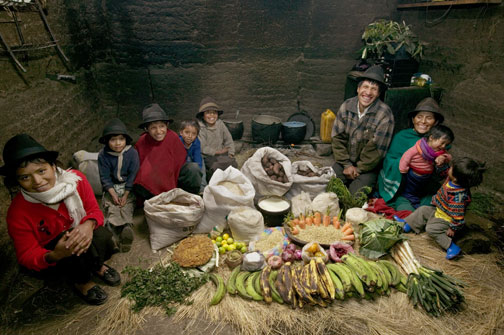 |
The Ayme family in their kitchen house in Tingo, Ecuador, a village in the central Andes, with one week’s worth of food. Ermelinda Ayme Sichigalo, 37, and Orlando Ayme, 35, sit flanked by their children (left to right): Livia, 15, Natalie, 8, Moises, 11, Alvarito, 4, Jessica, 10, Orlando hijo (Junior, held by Ermelinda), 9 months, and Mauricio, 30 months. Not in photograph: Lucia, 5, who lives with her grandparents to help them out. Cooking method: wood fire. Food preservation: natural drying. Food expenditure for one week: $31.55 USD. Photo: ©2005 Peter Menzel. From the book Hungry Planet: What the World Eats, Ten Speed Press |
|
 |
|
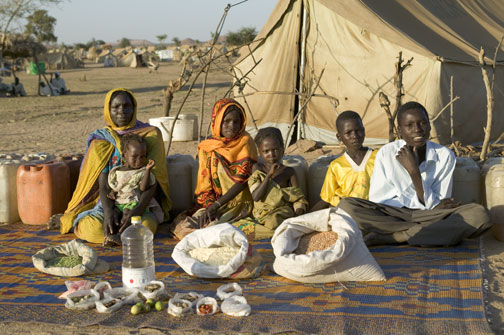
The Aboubakar family of Darfur province, Sudan, in front of their tent in the Breidjing Refugee Camp, in eastern Chad, with a week’s worth of food. D’jimia Ishakh Souleymane, 40, holds her daughter Hawa, 2; the other children are (left to right) Acha, 12, Mariam, 5, Youssouf, 8, and Abdel Kerim, 16. Cooking method: wood fire. Food preservation: natural drying. Food expenditure for one week: $1.23 USD. Photo: ©2005 Peter Menzel. From the book Hungry Planet: What the World Eats, Ten Speed Press |
|
 |
|
The Revis family in the kitchen of their home in suburban Raleigh, North Carolina, with a week’s worth of food. Ronald Revis, 39, and Rosemary Revis, 40, stand behind Rosemary’s sons from her first marriage, Brandon Demery, 16 (left), and Tyrone Demery, 14. Cooking methods: electric stove, toaster oven, microwave, outdoor BBQ. Food preservation: refrigerator-freezer. Food expenditure for one week: $341.98 USD. Photo: ©2005 Peter Menzel. From the book Hungry Planet: What the World Eats, Ten Speed Press |